Guide
Keep a surf log
Writing your sessions down is how you remember what works at your spot. What to note, on paper or in an app, and what a few weeks of notes teach you.

Why write it down
Memory sorts badly. You remember the big session. You forget the wind, the tide, and the three flat ones before it. A log keeps what you would lose.
- What works at your spot. Which swell, which wind, which tide.
- Your progress. Sessions from last winter, next to this one.
- The good sessions. A rating and a line, so you can find them again.
What to note
- The spot, the time, how long you stayed in.
- The swell: height, period and direction. The period matters as much as the height.
- The wind: strength and direction, and whether it was offshore or not.
- The tide and the coefficient. Tide and coefficient explains why it counts.
- The board. The same wave feels different on another one.
- The crowd. It changes the session as much as the swell.
- A rating out of 5. Be honest, and keep the same scale.
- One sentence. The one thing no number says. "Sandbar moved left, it closes out when it gets big."
How to start
- Note it right after. On the beach, in the car park, before the shower. Two minutes. By the evening you have already lost half of it.
- Start with four things: the spot, the conditions, a rating, one sentence. Add the rest later.
- Keep the same scale. If 3 means "fine" in November, it means "fine" in March.
- Note the flat sessions too. A bad day at your spot teaches as much as a good one. It shows what does not work.
- Note what you had, not what was forecast. The forecast is a guess. The water is the answer.
Paper or app
A paper log is simple. Nothing to install, one line per session. It has one weakness: the conditions. You write them from memory, or you open a forecast to copy them, and the forecast is not what you actually had in the water.
In an app, the conditions fill in on their own. You note the rating and the sentence, and the numbers are already there. The crew can see your sessions, and you see theirs.
What you learn after 20 sessions
Take your best sessions, the ones you rated 4 and 5. Look at what they have in common: the tide, the period, the wind. Something like this will come out, as an example: "my spot works on a rising mid tide, with more than 11 seconds."
That sentence is worth more than any star rating, because it comes from your spot. Then open a forecast and look for the same numbers. How to read a surf forecast shows how to read it with your sessions in mind.
In Corail
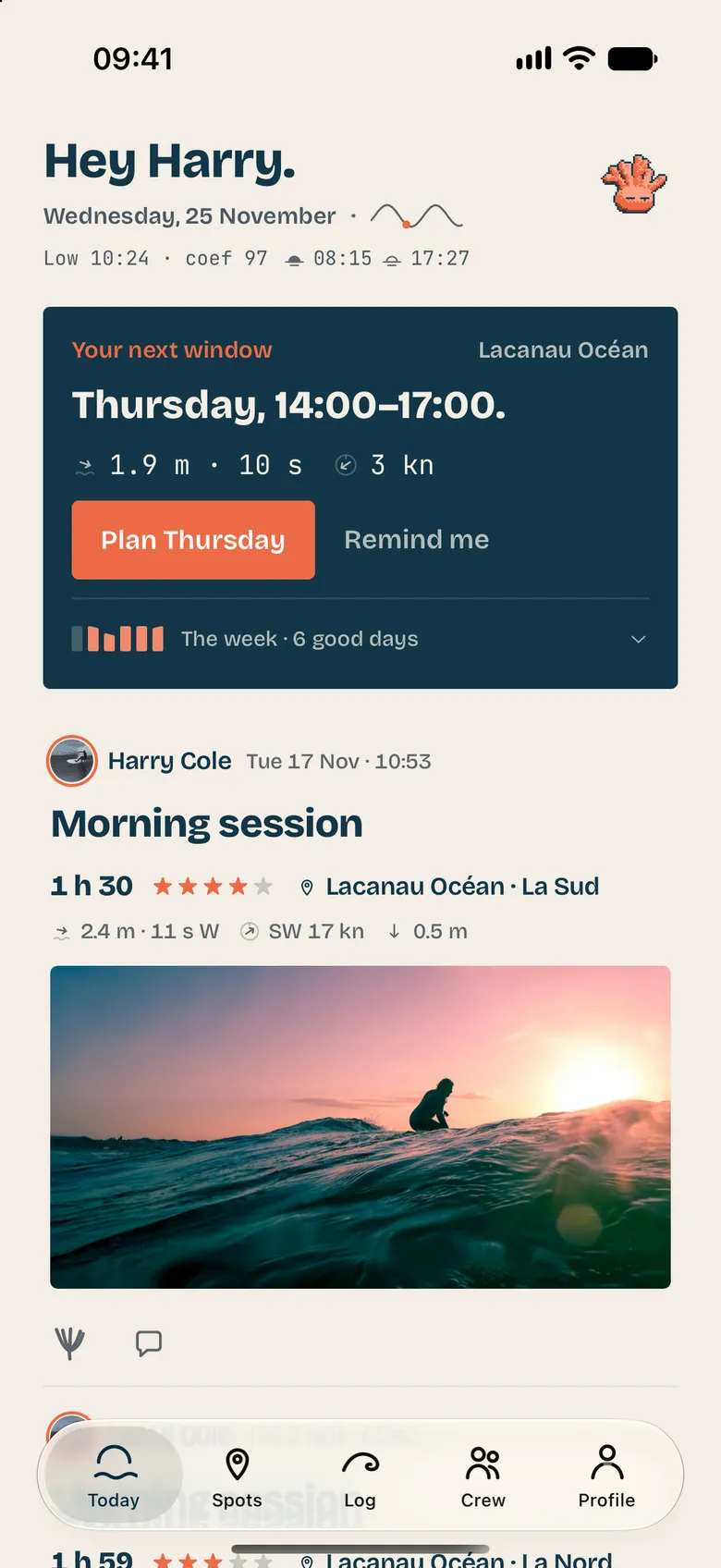
That is what Corail is for. Each session logs its swell, wind and tide on its own. You rate it in twenty seconds, or the watch counts your waves: track your sessions, with or without a watch. Your crew sees the sessions.
With Plus, each hour of the forecast is compared to your sessions rated 4 and 5. It is not a forecast app: why Corail keeps what happened.