Guide
Tide and coefficient: when to surf
Two tides a day, a coefficient from 20 to 120. What they change in the water, and why no coefficient is right for every spot.

The tide in a few lines
There are two tides a day. Count about 12 h 25 between two high tides. So everything slides by roughly 50 minutes a day: Tuesday's low tide is not Wednesday's.
The gap in height between high and low tide is the tidal range. It changes from one day to the next. That is what the coefficient tells you.
The coefficient
The coefficient is a number from 20 to 120, defined by the SHOM. It is worked out for Brest and used along the French coast. It is a French habit: outside France it is hardly used, so read the tide height instead.
100 is the average tidal range of the spring tides around the equinoxes. An average spring tide is about 95, an average neap tide about 45. Those are the two curves below. For the very big ones, see what changes in the water.
| Coefficient | The tide | In the water |
|---|---|---|
| 45 and under | Neap tides (the average is 45) | The water barely moves. The spot stays the same for longer. |
| Around 70 | Middling | Between the two. |
| 95 and over | Spring tides (the average is 95) | The water moves a lot and fast. Above 100, even more so. |
The coefficient changes little from one day to the next. It rises and falls over about two weeks, with the moon: the big ones come around the new moon and the full moon.
What it changes to the wave
With a big coefficient, low tide drops further. The waves break on less water. They get hollower, sometimes too hollow, and they can start to close out. The current is stronger too, along the beach and in the channels.
The water also moves faster: a spot can switch on and off within an hour. Check the time of low tide before you check the size.
With a small coefficient, the sea hardly moves. The spot keeps the same shape for hours, and you have more time to surf what works.
High tide, mid tide, low tide: it depends on the bottom
On a reef, the wave breaks on the same rock every time. It often needs enough water over it: mid tide or high tide. At low tide there is little water over the rock, and it forgives nothing.
On a beach break, it all depends on the sandbars. And the sandbars move with the storms: the tide that worked last month may not work this week.
On the Gironde and Landes coast, the baïnes are most dangerous around low tide: at the end of the falling tide and the start of the rising one. The current there is strong. Know where they are before you paddle out.
Before you go
- Find the time of low tide and of high tide for the day.
- Look at the coefficient. Big, expect fast water and a low tide that drops far. Small, expect a spot that holds.
- Put both against what you know of your spot: reef or sand, and the tide it likes.
There is no ideal coefficient
Someone will tell you to come at 70. That is true for their spot. Every spot has its own tide and its own coefficient, and they move with the sandbars and the swell.
You learn it in the water, session after session. Each time, keep three things: the tide (rising or falling, high or low), the coefficient, and how it was. After a few sessions, your spot starts to answer.
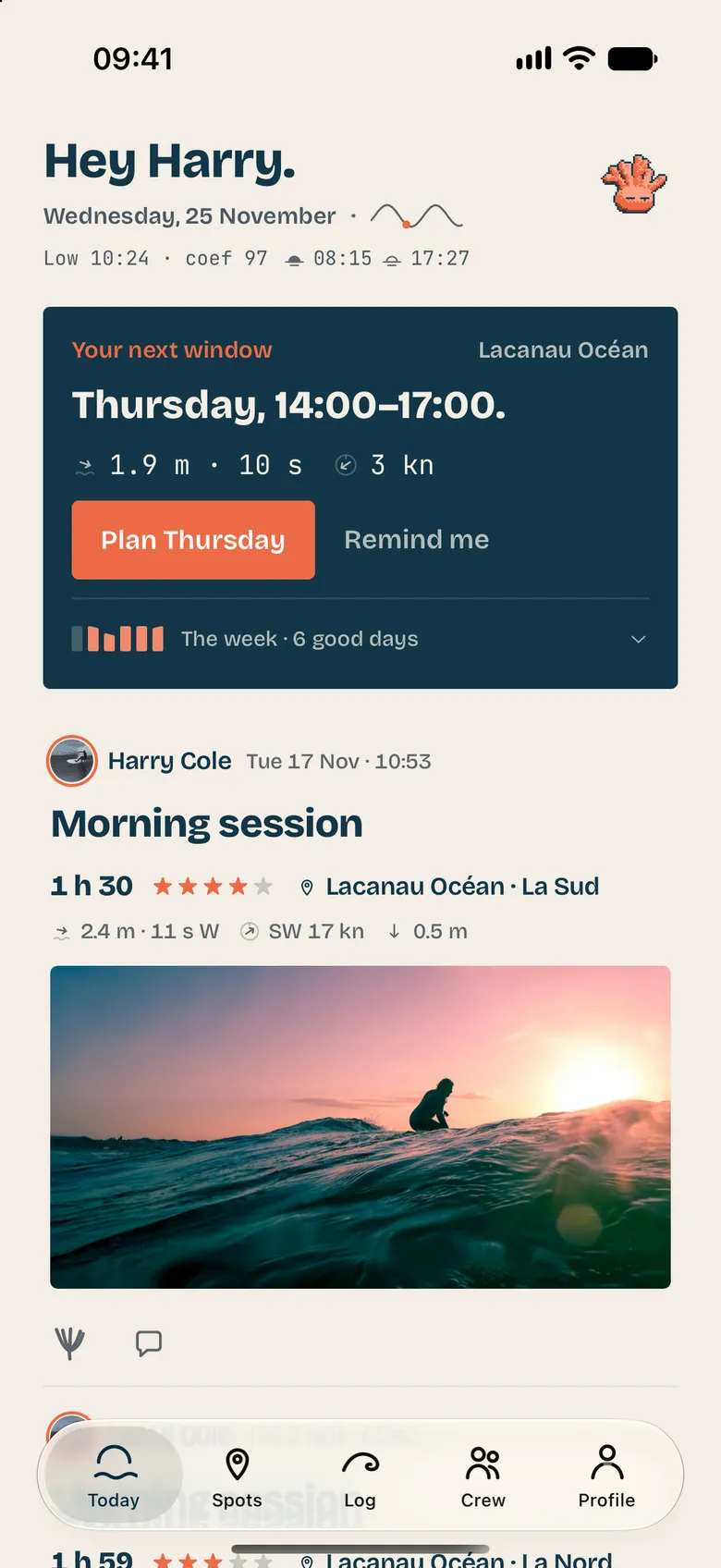
That is what a surf log keeps. In Corail, each session logs its swell, wind and tide on its own, so you see at which tide your spot works. Forecasts give the tide times and heights, and how to read a surf forecast covers the rest. Corail works out the coefficient from the Brest tide, with the SHOM method. The sources are listed on the data page.