Journal
Track your surf sessions, with or without a watch
You do not need a smartwatch to keep your sessions. A phone is enough. Here is what each way records, and which one to pick.

Most surfers do not own a smartwatch. That is not a reason to lose your sessions. A phone keeps nearly everything, as long as you know what it can note and what it cannot.
What a recorded session holds
A session in a log is four things.
- Where and when. The spot, the day, the time, how long you stayed in.
- The conditions. Swell, wind, tide. They come from the place and the time. No sensor on your wrist measures the swell.
- What you thought of it. A rating, one sentence. Nobody can write that for you.
- Your waves. How many, how fast, how far. This is the only part that needs something on you in the water.
Three out of four need no watch.
With your phone, before you paddle out
Start a timer when you leave for the water. Stop it when you come back. The phone stays dry, in the car or in the bag. It does not go in the water.
You get the exact start time and the exact time in the water, without having to remember them. That matters more than it looks: the conditions are read from that time. An hour off on a fast tide, and the log describes another session.
With your phone, after the fact
You forgot the timer, or you did not want to touch your phone before the session. Log it afterwards: the spot, the time, how long, a rating, one line.
One rule: do it soon. In the car park, before the shower. By the evening the start time has turned into "around nine", and the sentence you had in your head is gone. More on this in the surf log guide.
With a watch
The watch comes in the water with you. It starts the session, counts the waves from the GPS, and keeps the time, the top speed and the distance of each ride. The phone can stay in the car.
Those numbers are an estimate, and a wrist in the white water is a hard place for a GPS. What the watch does in Corail, and its limits, are in surfing with an Apple Watch.
Side by side
| What you keep | What is missing | |
|---|---|---|
| Timer on the phone | Spot, exact time and duration, conditions, rating, a line. | The waves. |
| After the fact | Spot, time and duration from memory, conditions, rating, a line. | The waves. And the exact time, if you wait too long. |
| Watch | All of the above, plus the waves: count, time, top speed, distance. | Nothing, but the wave numbers are an estimate. |
What you lose without a watch
The wave count, and the speed of each ride. That is all.
What you keep is what teaches you about your spot: which swell, which period, which tide gave you your best sessions. A wave count does not say that. Twenty rated sessions do, watch or not.
The wave numbers are useful for something else: seeing how much you actually surf in a two-hour session, and comparing one board with another. What to do with them is in log your sessions to get better.
Which one to pick
- No watch: the timer when you think of it, after the fact when you do not. Both give the same log.
- A watch: wear it. On the days you leave it at home, log with the phone. The session counts the same.
- In every case: rate it and write one line. No device does that part.
In Corail
Corail has the three ways. The timer when you leave for the water. After the fact, in twenty seconds. Or the Apple Watch alone, with the phone in the car. Each session then logs its swell, wind and tide on its own, and your crew sees it.
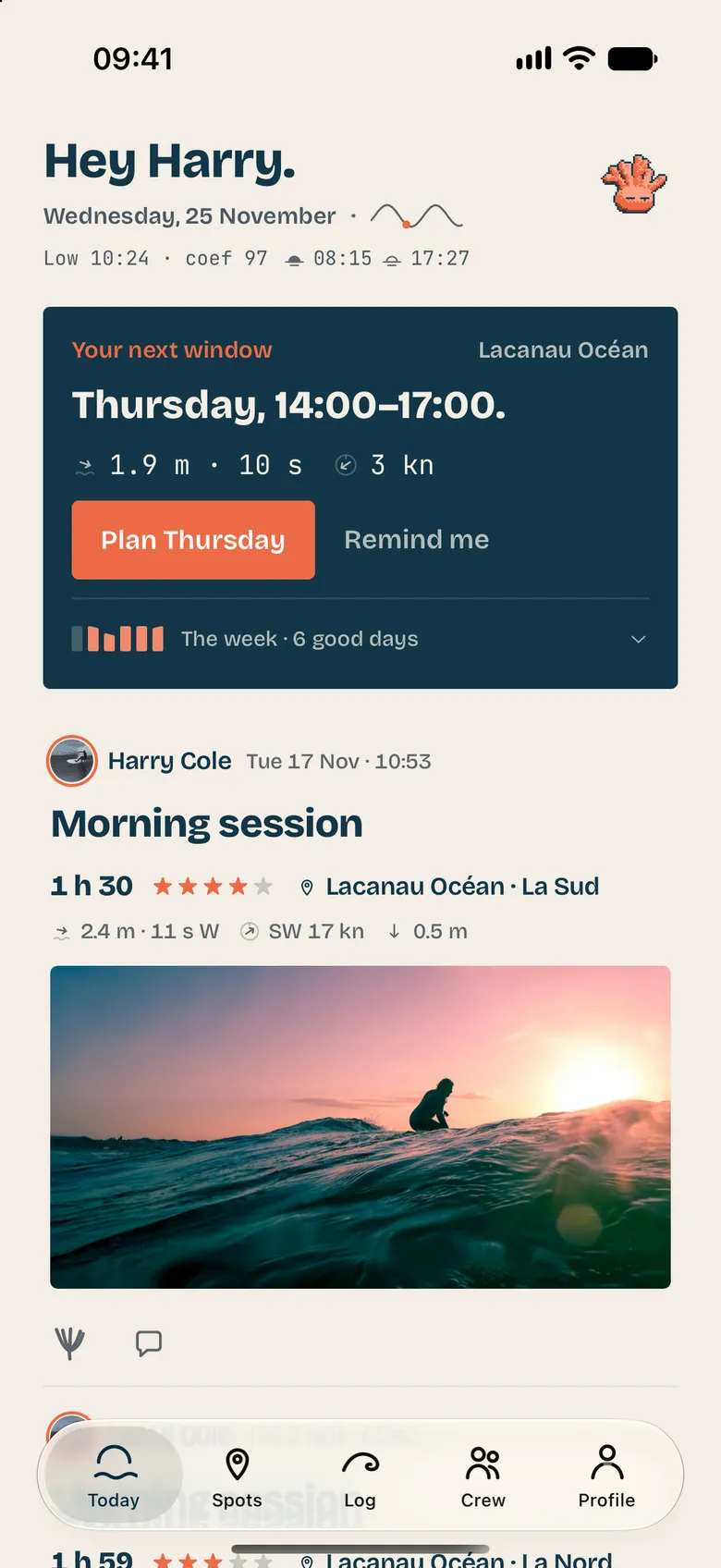
The three ways are free. The wave by wave detail from the watch is part of Corail Plus.